
Knowledge Center
The Knowledge Center is your gateway to understanding the science behind peptide and small molecule analytics. Here, we provide concise explanations of key biological pathways, insights into analytical methods, practical tutorials for sample handling and data interpretation, and a glossary of essential terms.
Whether you are exploring our services for the first time or seeking deeper technical guidance, this section helps you navigate complex concepts with clarity and confidence.
Background & Pathways
The Renin-Angiotensin-System (RAS) is critically involved in the regulation of blood pressure and fluid balance and is responsible for the control of a variety of complex physiological functions.
The peptide hormone system is constituted by multiple enzymes, giving rise to a meshwork of effector peptides. These peptides mediate
their functions through binding to specific receptors which leads to an integrated physiologic response.
The RAS can be formally divided into two branches: On the one hand there is the classical RAS, whose main effector peptide is the cardiovascular “bad guy” Angiotensin II (Ang 1-8); on the other hand there is the alternative RAS with its main effector Ang 1-7, which is known to bind the receptor MAS, transducing signals that counteract effects mediated by Ang II and thereby being beneficial in RAS-associated diseases.
The balance between the two branches depends on many enzymes and serves as a common therapeutic target in cardiovascular diseases. Little is known about the functions of other metabolites of the RAS, although there is growing evidence for the importance of other angiotensin metabolites, enzymes and receptors of the RAS.
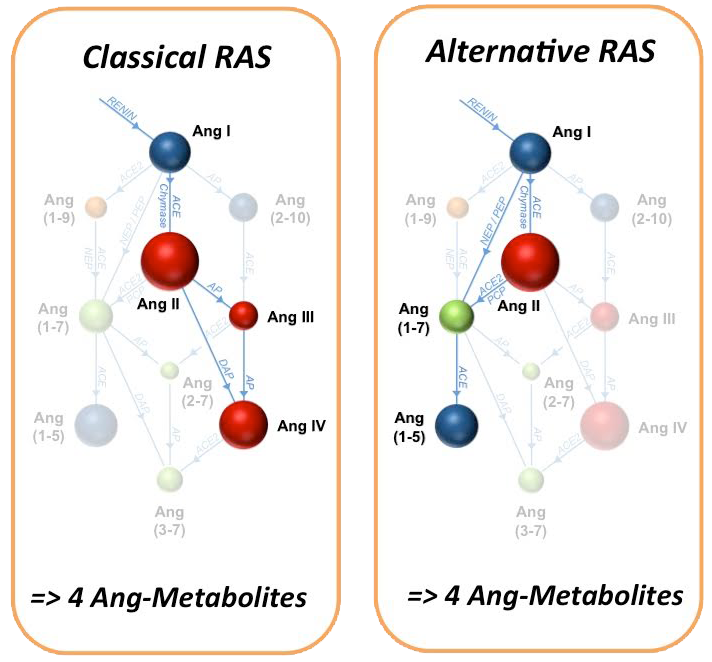
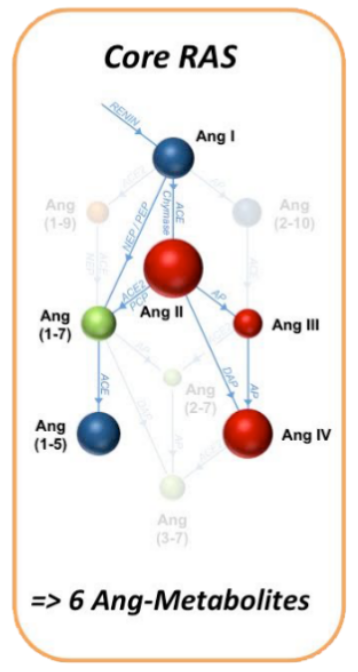
The core RAS represents the central enzymatic backbone of the system and provides a robust baseline for functional characterization.
Comprehensive RAS profiling integrates classical, alternative, and additional angiotensin metabolites, enabling a holistic view of system activity.
Learn more about Attoquant’s unique angiotensin quantification service.
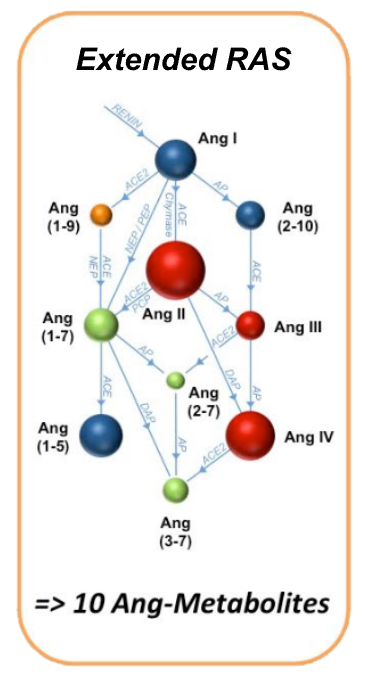
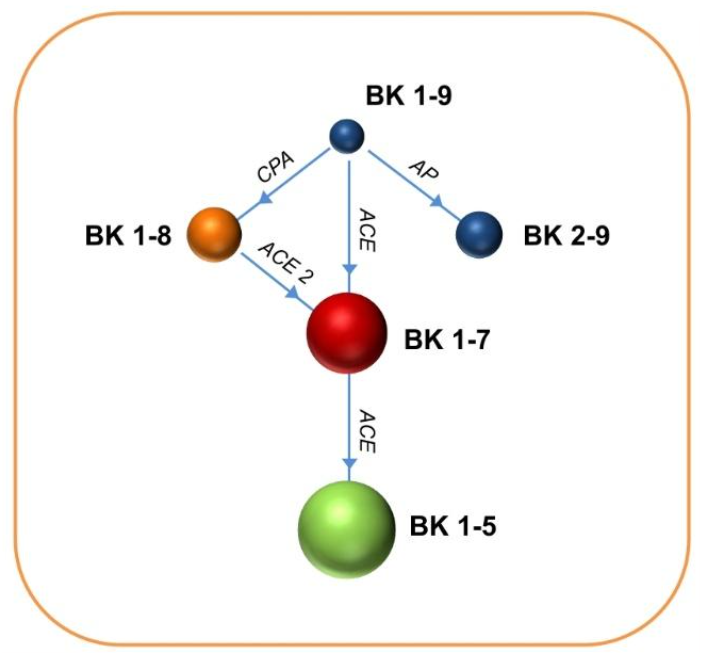
The Kallikrein–Kinin System (KKS) plays a central role in the regulation of vascular tone, inflammation, and endothelial function. This peptide hormone system is composed of multiple enzymes and precursor proteins, giving rise to a network of bradykinin peptides and related metabolites. These peptides exert their effects by binding to specific receptors, such as B1 and B2, triggering integrated physiological responses that influence blood pressure, vascular permeability, and inflammatory signaling.
The KKS can be conceptually divided into two main axes: one driven by bradykinin (BK 1–9) and its active metabolites, which mediate vasodilation and anti inflammatory effects, and a second axis involving des-Arg9-bradykinin and other metabolites, which can promote pro inflammatory or tissue-specific responses. The dynamic balance between these axes is finely regulated by multiple enzymes, including kallikreins, ACE, and neprilysin, and is a key target in cardiovascular, renal, and inflammatory disorders.
Attoquant Diagnostics provides high-resolution bradykinin quantification, capturing the full spectrum of KKS peptides in plasma, tissues, and other biological matrices. Our approach enables researchers to monitor pathway activity, study disease mechanisms, and assess therapeutic interventions with confidence.
The Endothelin system is a crucial regulator of vascular tone, blood pressure, and cardiovascular homeostasis. Endothelins are potent peptide hormones that exert their effects by binding to specific receptors (ETA and ETB), influencing vasoconstriction, cell proliferation, and renal function. Dysregulation of endothelin signaling has been implicated in a variety of cardiovascular, renal, and pulmonary diseases, making it a key focus for both basic research and therapeutic development.
Attoquant Diagnostics provides high precision quantification of endothelin peptides, covering plasma, serum, tissue, and other biological matrices. Our assays deliver detailed insights into endothelin pathway activity, enabling researchers to investigate disease mechanisms, monitor pharmacological interventions, and integrate endothelin data with complementary peptide or biomarker analyses.
Key Peptides & Small Molecules
Renin–Angiotensin System (RAS)
-
- Angiotensin I (Ang I, 1–10)
Inactive precursor peptide and inital substrate of the RAS. - Angiotensin II (Ang II, 1–8)
Main effector of the classical RAS with vasoconstrictive, pro-inflammatory, and profibrotic effects. - Angiotensin 1–7 (Ang 1–7)
Key effector of the alternative RAS with vasodilatory and protective properties. - Other angiotensin metabolites (Ang 1–9, Ang 2–8, Ang 3–8, Ang 2–7, Ang 3–7)
Provide insight into enzymatic activity, pathway balance, and therapeutic effects. - Aldosterone (optional, if measured)
Downstream hormone of the RAS, crucial for fluid and electrolyte balance.
- Angiotensin I (Ang I, 1–10)
Kallikrein–Kinin System (KKS)
-
- Bradykinin (BK 1–9)
Central vasoactive peptide with strong vasodilatory and pro-inflammatory effects. - Des-Arg⁹-Bradykinin (BK 1–8)
Metabolite acting primarily via the B1 receptor, especially in inflammation. - Kallidin (Lys-BK, 1–10)
Precursor peptide contributing to local kinin activity.
- Bradykinin (BK 1–9)
Endothelin System
-
- Endothelin-1 (ET-1)
Potent vasoconstrictor with roles in cardiovascular, renal, and pulmonary physiology. - Endothelin-2 (ET-2) and Endothelin-3 (ET-3)
Additional isoforms with tissue-specific effects and complementary functions.
- Endothelin-1 (ET-1)
Other Small Molecules (representative examples)
-
- Apelin – bioactive peptide with cardiovascular and metabolic effects.
- Steroids (e.g., cortisol, aldosterone) – hormone mediators linked to RAS and KKS activity.
- Drug levels / PK compounds – for pharmacokinetic studies and pathway modulation.
Methods & Techniques

High-Precision Mass Spectrometry
Attoquant Diagnostics leverages ultra-pressure liquid chromatography-tandem mass spectrometry (LC-MS/MS) with stable isotopelabeled or deuterated internal standards for all assays.
This approach ensures exceptional specificity and sensitivity, allowing accurate detection of multiple peptides and small molecules in the low picomolar range across plasma, serum, tissue, and other biological matrices.
Sample Handling & Stabilization
Accurate measurement starts at the moment of sample collection. We will guide you through the system-specific challenges in sample
handling to avoid any pitfalls which may affect the outcome of your entire study or experiment.
Enzyme Activity Assays
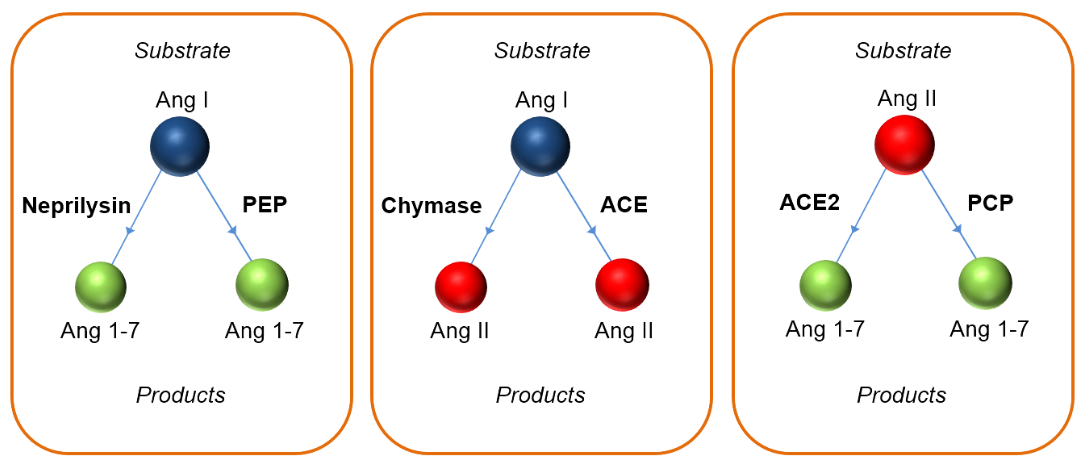
Protease activities in plasma and tissue are measured using natural substrates, capturing the true enzymatic turnover rather than artificial cleavage products. Specific inhibitors and calibration with recombinant enzymes in the original sample matrix guarantee high selectivity and accuracy, even for low-abundance enzymes.
(For example, Neprilysin activity is determined by monitoring Ang I
conversion to Ang 1–7 in the presence and absence of a specific
Neprilysin inhibitor.)
Standard & Custom Panels
We provide comprehensive panels for routine analytes, such as Angiotensin, Bradykinin, Endothelin, and selected small molecules.
Additionally, our team can design custom panels tailored to your research needs, ensuring optimal coverage of the pathways relevant to
your study.
Glossary
Angiotensin (Ang I, Ang II, Ang 1–7, etc.)
Peptides of the Renin–Angiotensin System (RAS) that regulate blood pressure, fluid balance, and vascular function. Different metabolites reflect enzymatic activity and pathway balance.
Aldosterone
Mineralocorticoid hormone downstream of Ang II, involved in sodium and water homeostasis.
Bradykinin (BK 1–9)
Vasoactive peptide of the Kallikrein–Kinin System (KKS), inducing vasodilation and inflammation
Des-Arg⁹-Bradykinin (BK 1–8)
Metabolite of bradykinin acting primarily via the B1 receptor.
Endothelin (ET-1, ET-2, ET-3)
Peptides controlling vascular tone, cardiac function, and cell proliferation; ET-1 is the primary isoform in the cardiovascular system.
LC-MS/MS (Liquid Chromatography–Tandem Mass Spectrometry)
Analytical method for precise, highly specific quantification of peptides and small molecules.
Protease / Enzyme Assay
Measurement of enzymatic activity in plasma, serum, tissue, or cells using natural substrates and selective inhibitors.
Custom Panel
Tailored set of analytes designed to meet specific research or clinical study requirements.
Limit of Quantification (LOQ)
Lowest analyte concentration that can be quantified with acceptable accuracy and precision.
RAS-Fingerprint™
Comprehensive analysis of multiple angiotensin metabolites in plasma, serum, or tissue to provide a pathway-level view of the Renin–
Angiotensin System.
Sample Matrix
Type of biological sample used for analysis (e.g., plasma, serum, tissue, urine, CSF).
Protease Inhibitor Cocktail
Chemical mixture added to samples immediately after collection to prevent degradation of peptides by endogenous enzymes.
Get in touch
Visit us
Attoquant Diagnostics GmbH
Brehmstraße 14A
1110 Vienna
Austria
